About me
Last update: Jul. 2026
I am currently a postdoctoral fellow in Department of Earth, Environmental & Planetary Sciences (DEEPS) at Brown University. My current advisors are Dr. Baylor Fox-Kemper and Dr. Emanuele Di Lorenzo from DEEPS. Before coming to Brown, I was a postdoctoral fellow in Graduate Aerospace Laboratories (GALCIT) at Caltech. I earned my Ph.D. degree in Department of Mechanical Engineering at Pennsylvania State University.
My research interest is in advancing scientific understanding of turbulent fluid system through the combination of artificial intelligence, statistical methods, and physical theory. I explore the connection between canonical flows and real-world applications, which requires the combination of turbulence research and climate science, examining how flow elements like rotation and stratification can be integrated into a multi-scale dynamical system to serve human needs such as coastal resilience.
My research
AI for science is rapidly growing, providing more than new tools for existing fluid problems. It also renovates research paradigms for extracting physical mechanisms from diverse data sources and for modeling heterogeneous dynamical systems such as regional oceans.
I have worked extensively with turbulence modeling for canonical flows, including rotating wall-bounded flows and stratified wake flows. I developed models for them, created handy tools for model calibration and model selection, and evaluated their capabilities in terms of resolved physics, uncertainty level, and numerical gap. They start with canonical flows, and eventually serve as components to augment physical simulations in a generalized scope.
At Brown University, I am exploring another approach that further bypasses small-scale interactions and builds connections between observables and forcings, i.e., boundary conditions in simulation, through ocean model emulators. (See my post for more terminology differences between climate scientists and fluid dynamics scientists.) This approach creates more accessible interpretations for local communities, but comes with a case-specific nature.
There are so many contributions we can make to the fluid world, and I welcome discussions on any topics on turbulence research, climate science, and a broad range of fluid mechanics!
Bio
- Postdoctoral scholar research associate in DEEPS, Brown, Sep. 2025 - Present
- Postdoctoral scholar research associate in GALCIT, Caltech, Aug. 2023 - Jul. 2025
- Ph.D. in Mechanical Engineering, The Pennsylvania State University, Aug. 2018 - May 2023
- Bachelor of Engineering, Tsinghua University, Aug. 2014 - Jun. 2018
- Bachelor of Mathematics and Applied Math, Tsinghua University, Aug. 2015 – Jun. 2018
News
[2026/10] Delivered an invited seminar titled ‘How can machine learning assist coastal ocean modeling?’ in Fall 2026 Physical Oceanography Seminar Series, at GSO, URI. URI has a great environment for scientific discussion.
[2026/05] My single-author project in the Sixth Madrid Turbuelence Workshop has its proceeding ready online. It is a fun try on learning the physics of wall modeled turbulence!
[2026/01] Our paper on consistency in data-driven LES modeling is now online. Please check the link.
[2025/11] Our paper on consistency in data-driven LES modeling has been accepted! Please check the arXiv link.
[2025/08] Join Fox-Kemper group and Di Lorenzo group in DEEPS at Brown as a postdoctoral fellow!
[2025/06] Lead a single-author project in the Sixth Madrid Turbulence Workshop at Universidad Politecnica de Madrid in Madrid, Spain. The proceeding will come in the near future.
[2025/01] Xinyi and Jiaqi’s paper on the meandering in a stratified wake comes online, please check out the link!
[2024/06] Participate in CTR Summer Program 2024 at Stanford University, and the proceeding has come out.
[2024/05] Selected for the 2024 Future Leaders in Aerospace Symposium, held in Stanford, CA. Check out the news.
[2023/08] Join Bae group in GALCIT at Caltech as a postdoctoral fellow!
[2023/02] Finish my Ph.D. defense. See my Ph.D. dissertation here! (Title: Data-driven approach for turbulence modeling in rotating flows and stratified flows)
[bib]
Selected publications
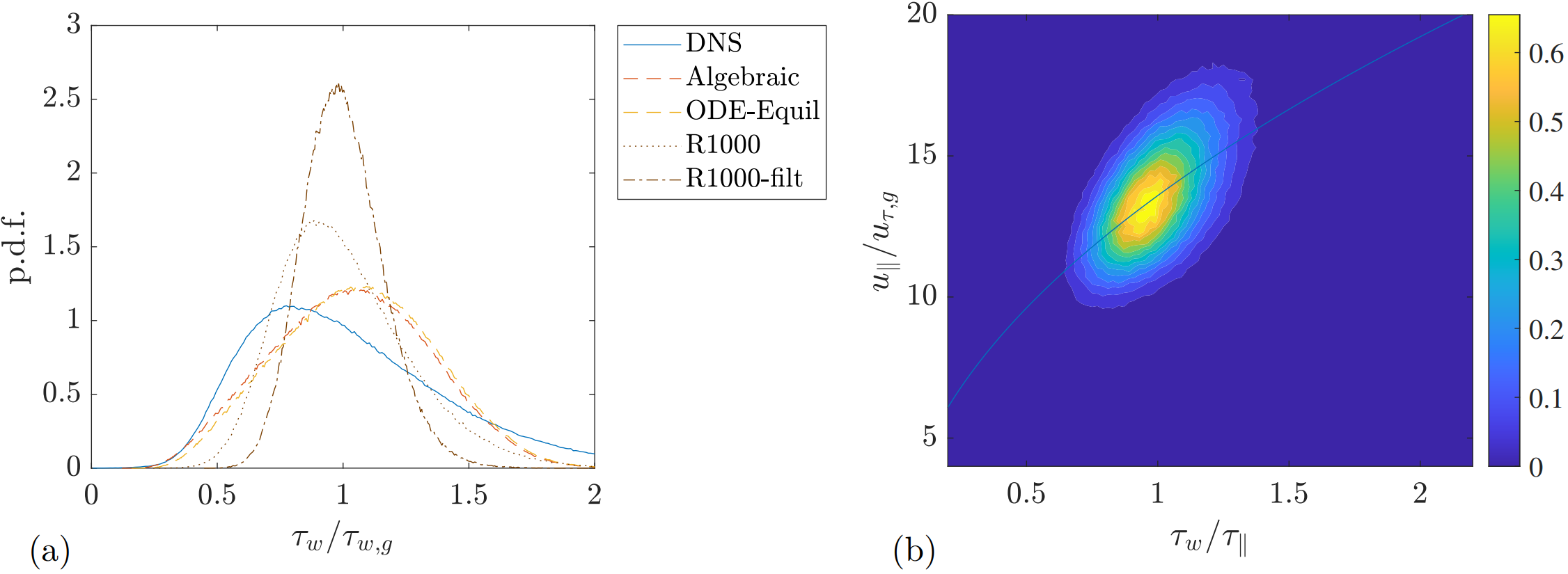
How does wall modeling impact the momentum transfer of modeled wall turbulence?
Xinyi Huang (2026)
All wall models use the assumption that instaneneous profiles follow the mean, but is that true? I diagnose the assumption and explain why this could be troublesome.[bib,doi,pdf]
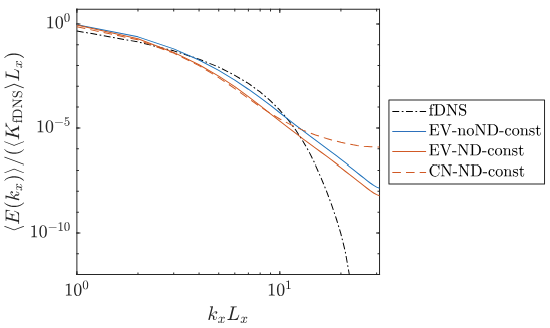
Consistency requirement of data-driven subgrid-scale modeling in large-eddy simulation
Xinyi Huang, Sze Chai Leung, & H. Jane Bae (2026)
Comparing the a priori tests and the a posteriori tests, we identify the numerical deviation between them and highlight its importance in achieving accurate model predictions.[bib,doi,pdf]
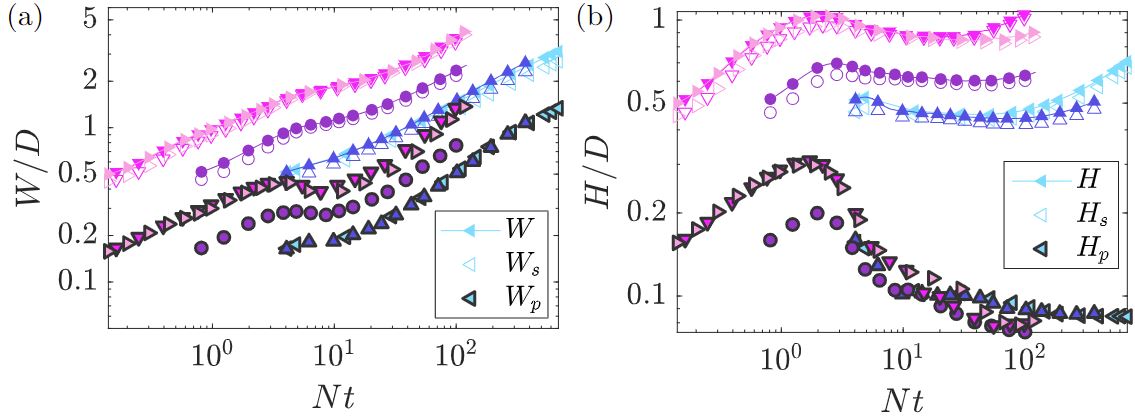
The characteristics of the meandering effect in a stratified wake
Xinyi Huang, & Jiaqi Li (2024)
Isolating meandering effect, we find that the large-scale meandering motion has little effect on changing the scaling of the mean velocity, but it is one of the main reasons for possible deviation from the Gaussian assumptions. Therefore, treating horizontal and vertical directions similarly is not wise even for small-scale turbulence.[bib,doi,pdf]
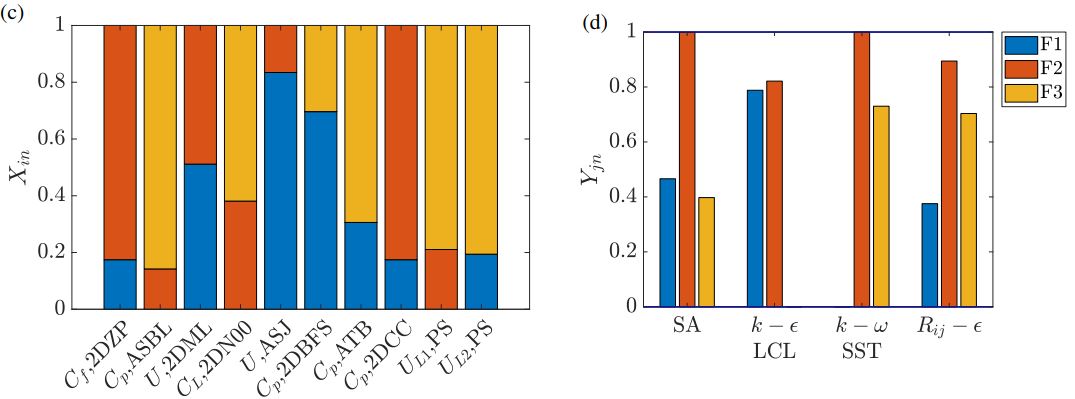
Distilling experience into a physically interpretable recommender system for computational model selection
Xinyi Huang, Thomas Chyczewski, Zhenhua Xia, Robert Kunz, & Xiang Yang (2023)
We distill human experience into a recommender system to do computational model selection of RANS models. [bib,doi,pdf]
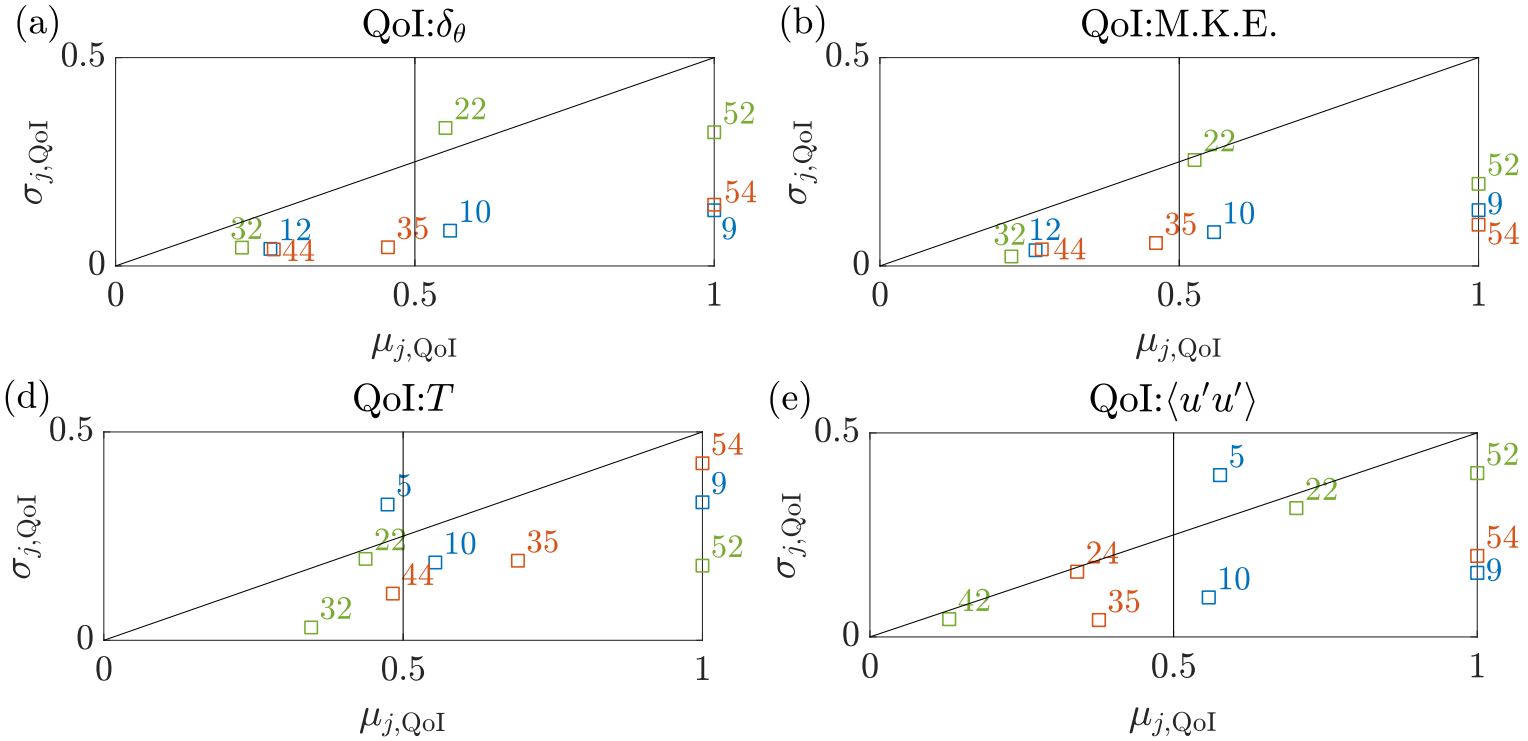
Determining a priori a RANS model’s applicable range via global epistemic uncertainty quantification
Xinyi Huang, Naman Jain, Robert Kunz, & Xiang Yang (2021)
The global epistemic uncertainty quantification evaluate the effectiveness and consistency of a model term, and provide guidance in model calibration a priori.[bib,doi,pdf]
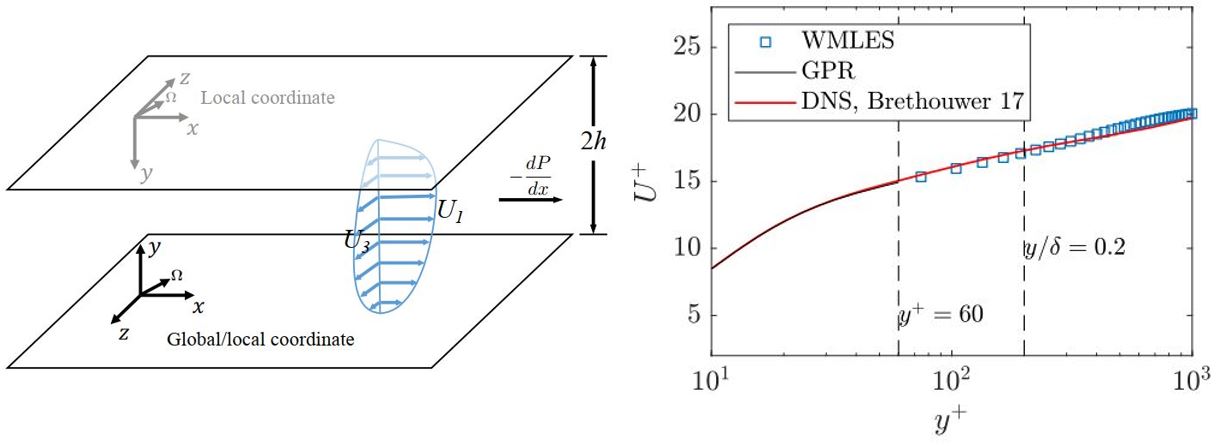
A Bayesian approach to the mean flow in a channel with small but arbitrarily directional system rotation
Xinyi Huang, & Xiang Yang (2021)
We use Bayesian approach to effienciently sample the flow controlling parameter space, and provide a surrogate model for a channel with arbitrarily directional system rotation. [bib,doi,pdf]
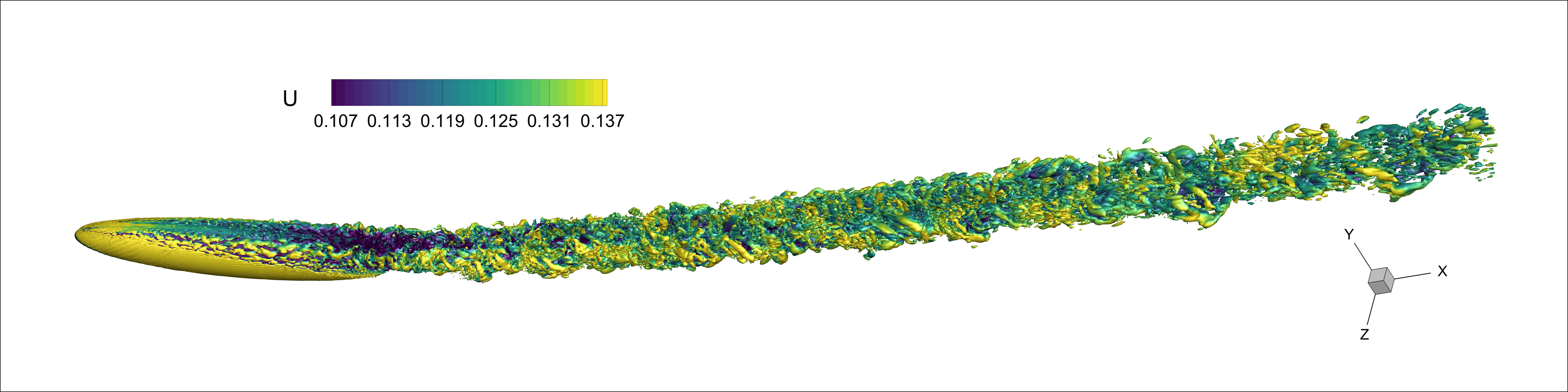
Wall-modeled LES of flow around a prolate spheroid at various angles of attack
Xinyi Huang, & Xiang Yang (2019)
We simulate wall-modeled LES for flow around a 6:1 prolate spheroid at various angles of attack, and provide the statistics and vortex structures.
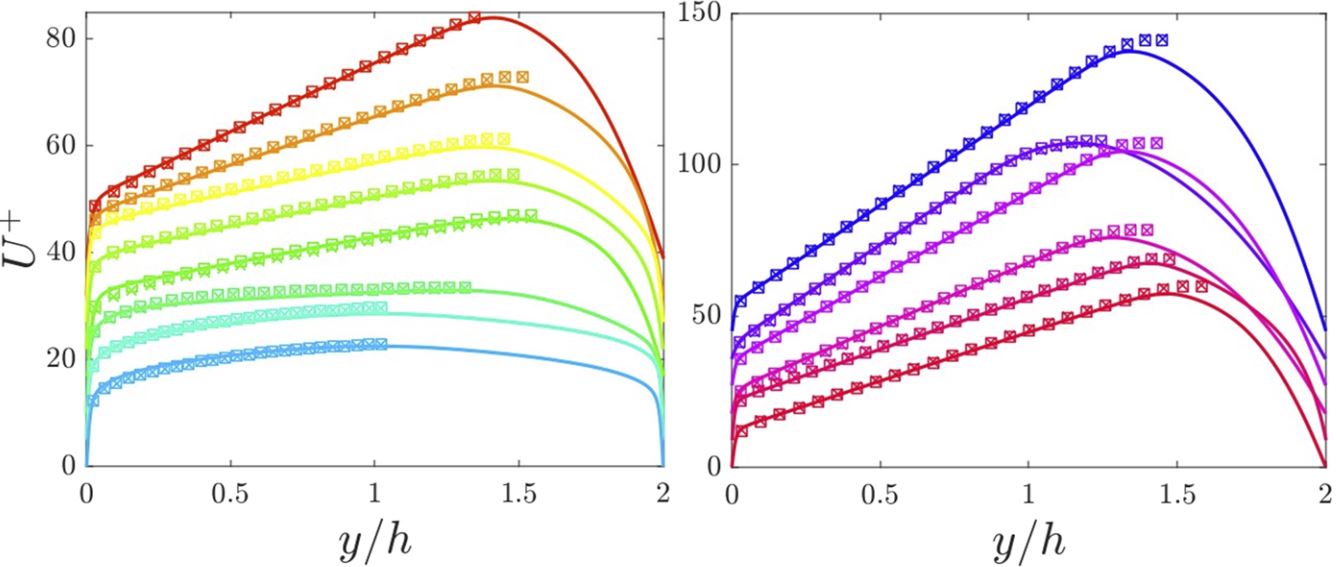
Wall-modeled large-eddy simulations of spanwise rotating turbulent channels—Comparing a physics-based approach and a data-based approach
Xinyi Huang, Xiang Yang, & Robert F. Kunz (2019)
We develop wall modeling capabilities for a channel flow subjected to spanwise roation, and compare a physics-based approach and a data-based approach. [bib,doi,pdf]
Publication list
- Huang, X. (2026). How does wall modeling impact the momentum transfer of modeled wall turbulence?. In Journal of Physics: Conference Series (Vol. 3230, No. 1, p. 012023). IOP Publishing. [bib,doi,pdf]
- Huang, X., Leung, S. C., & Bae, H. J. (2026). Consistency requirement of data-driven subgrid-scale modeling in large-eddy simulation. Phys. Rev. Fluids, 11(1), 014602. [bib,doi,pdf]
- Huang, X., & Li, J. J. L. (2025). The characteristics of the meandering effect in a stratified wake. Phys. Rev. Fluids, 10(1), 014602. [bib,doi,pdf]
- Huang, X., Chyczewski T., Xia Z., Kunz, R. F., & Yang, X. I. A. (2023). Distilling experience into a physically interpretable recommender system for computational model selection. Sci. Rep., 13, 2225 [bib,doi,pdf]
- Huang, X., Kunz, R. F., & Yang, X. I. A. (2023). Linear Logistic Regression with Weight Thresholding for Flow Regime Classification of a Stratified Wake. Theor. Appl. Mech. Lett., 100414. [bib,doi,pdf]
- Jain, N., Huang, X., Li, J. J. L., Yang, X. I. A. and Kunz, R. F. (2023). An Assessment of Second Moment Closure Modeling for Stratified Wakes Using Direct Numerical Simulations Ensembles. J. Fluids Eng., 145(9). [bib,doi,pdf]
- Jain, N., Pham, H. T., Huang, X., Sarkar, S., Yang, X., & Kunz, R. (2022). Second Moment Closure Modeling and Direct Numerical Simulation of Stratified Shear Layers. J. Fluids Eng., 144(4), 041102. [bib,doi,pdf]
- Huang, X., Jain, N., Abkar, M., Kunz, R. F., & Yang, X. I. A. (2021). Determining a priori a RANS model’s applicable range via global epistemic uncertainty quantification. Comput. Fluids, 230, 105113. [bib,doi,pdf]
- Huang, X., & Yang, X. I. A. (2021). A Bayesian approach to the mean flow in a channel with small but arbitrarily directional system rotation. Phys. Fluids, 33(1), 015103. [bib,doi,pdf]
- Lv, Y., Huang, X., Yang, X., & Yang, X. I. (2021). Wall-model integrated computational framework for large-eddy simulations of wall-bounded flows. Phys. Fluids, 33(12), 125120. [bib,doi,pdf]
- Yang, X. I. A., Hong, J., Lee, M., & Huang, X. (2021). Grid resolution requirement for resolving rare and high intensity wall-shear stress events in direct numerical simulations. Phys. Rev. Fluids, 6(5), 054603. (Editors’ suggestion) [bib,doi,pdf]
- Kumar, S. S., Huang, X., Yang, X., & Hong, J. (2021). Three dimensional flow motions in the viscous sublayer. Theor. Appl. Mech. Lett., 11(2), 100239. [bib,doi,pdf]
- Huang, X., Yang, X. I. A., & Kunz, R. F. (2019). Wall-modeled large-eddy simulations of spanwise rotating turbulent channels—Comparing a physics-based approach and a data-based approach. Phys. Fluids, 31(12), 125105. [bib,doi,pdf]
- Yang, X. I. A., Xu, H. H. A., Huang, X., & Ge, M. W. (2019). Drag forces on sparsely packed cube arrays. J. Fluid Mech., 880, 992-1019. [bib,doi,pdf]
Selected conference presentations
- Xinyi Huang. How does wall modeling impact the momentum transfer of the modeled wall turbulence? Bulletin of the American Physical Society (2025).
- Xinyi Huang, Sze Chai Leung, & Jane Bae. Numerical error of explicitly filtered large-eddy simulation for consistent data-driven modeling. Bulletin of the American Physical Society (2024).
- Xinyi Huang, Jiaqi Li, & Xiang Yang. “The characteristics of the meandering effect in a stratified wake.” Bulletin of the American Physical Society (2023).
- Xinyi Huang, Robert Kunz, & Xiang Yang. “Linear logistic regression with weight thresholding for flow regime classification of a stratified wake.” Bulletin of the American Physical Society (2022).
- Xinyi Huang, Robert Kunz, & Xiang Yang. “Data-driven computational model selection via recommender systems.” Bulletin of the American Physical Society, 66 (2021).
- Xinyi Huang, Naman Jain, Robert Kunz, & Xiang Yang. “Epistemic uncertainty quantification of Reynolds stress models.” Bulletin of the American Physical Society (2020).
- Xinyi Huang, & Xiang Yang. “Wall-modeled LES of flow around a prolate spheroid at various angles of attack.” Bulletin of the American Physical Society, 64 (2019).
Contact me
Email: xinyih@brown.edu
Extra fun materials
- I started with turbulence research and then worked on cross-disciplinary topics in geophysical fluid dynamics (GFD) and climate science. I learned a lot of new stuffs in GFD, so I made a cheat sheet for people who might have a similar situation! For a rigorous derivation for GFD equations, please check Jinyuan’s website!
- An essay regarding the discrete feature of the scientific communities (in Chinese only).
- Climate emulator is interesting, but the question is: how can climate scientists, fluid dynamics scientists, and applied mathematicians communicate smoothly among different communities? Check out this cheat sheet for your reference!
- I did a lot of interesting outreach podcasts, please check out my posts on Science on Tap!
Other resources for graduate students and postdocs
- For early career researcher, Early Career Symposium for Aerospace, Future Leaders in Aerospace is a good resource. Xinyi participated in the 2024 Symposium. Here is a link to the 2026 Symposium.
- Graduate student only, geophysical fluid dynamics program, hosting dozens of rising stars in GFD and a great place for building connection. See this website for more details, and pay attention to other summer possibilities by WHOI, UCSD/Scripps, etc, e.g., WHOI/NASA Summer School in Sea Level Science.
- For all career stages, Summer program for turbulence researcher, Center for Turbulence Research Biennial Summer Program at Stanford University. Xinyi participated in the 2024 CTR SP. Here is a link to the general info.
- For early career researcher, Summer program for turbulence researcher, Madrid Turbulence Workshop, also held biennially. Be aware that this may discontinue at some point. See this link for past occurrence. Xinyi led a single-author project in 2025 Madrid SP.
- For early career researcher, for all areas in division of engineering and applied science, EAS Trailblazers Symposium at Caltech, is another great opportunity to share your good work and insights. It is held in Oct. annually, and due in Mar.. Check this link.
- A lot of local fun research symposiums covering a lot of topics, often targeting early career scientists. Please check Gordon Research Conference.
- Other turbulence program, e.g., Lille Turbulence Program.
- Applied math programs are often held at ICERM (The Institute for Computational and Experimental Research in Mathematics) at Brown Unversity. Please check this link and see their programs.
- I put in some technical notes for other people regarding Brown OSCAR, LESGO, and coding tips.
Friends
- Jinyuan Liu knows something about turbulence.
- Jiaqi Li also knows something about turbulence.
- Yixuan Song will be your source of new friends when you are new to a place. This is how I got to meet many people at Penn State. :)
- Laixi Shi is always thinking about a line to introduce herself… (updated 2025)
- Jiarong Wu, all about waves and turbulence at the air-sea interface.
